

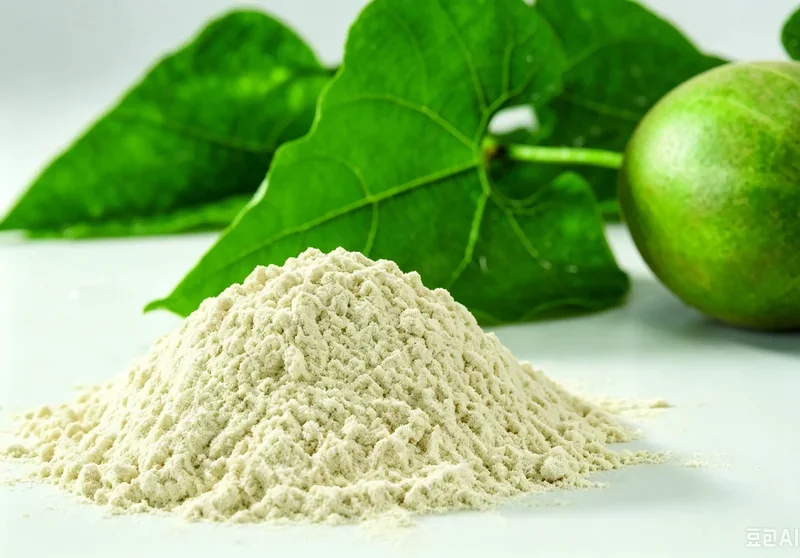
The inaugural Guangxi TCM Industry Exchange Conference opened 21 July 2023 at the Nanning International Convention and Exhibition Center, drawing 800-plus delegates from 25 provinces under the theme "new gathering of TCM, new integration of industry." Exhibitors joined on home ground with plant extracts and natural aromatic materials drawn from Guangxi's medicinal-food plants, not commodities. Every lot travelled with a certificate of analysis and a retained sample filed against its batch.
The Home-Province Conference, and Why We Stood on Our Own Ground
The first Guangxi TCM Industry Exchange Conference ran from 21 July 2023 at the Nanning International Convention and Exhibition Center, convened by seven provincial bodies — the Health Commission, the TCM Administration, the Industry and Information Technology Department, the Market Regulation Administration, the Investment Promotion Bureau, Guangxi University of Traditional Chinese Medicine and the Guangxi Agribusiness Group. More than 800 experts, scholars, entrepreneurs and practitioners came from 25 provinces, and a 33,000 m² exhibition and experience zone ran alongside five theme conferences, nineteen parallel sessions and an investment matchmaking forum. On opening day, 23 projects worth about 7 billion RMB in intended investment were signed.
We went because this was a home game. Most shows we attend sit in someone else's city — Chicago, Paris, Shanghai, Fuzhou. This one was in Guangxi, where the headline words are 桂十味, 道地药材 and 药食同源, and where our plant extracts already come from the soil. Standing in our own province's industry conference meant we were not introducing ourselves to a market; we were showing the province what its own pantry looks like once it is turned into an ingredient.
What the Province Put on the Table
The conference did more than talk. It published the Guangxi volume of the China Traditional Chinese Medicine Resources Compendium — 6,472 medicinal species catalogued across 23 books — and released the Guangxi Authentic Medicinal Materials Directory (64 entries) together with the Guangxi Minority Medicinal Materials Directory (47 entries) and the province's first Top Ten Medicinal Diets. Academicians Zhang Boli and Huang Luqi set the direction: Zhang on turning Guangxi's "ten famous flavors" into product strength and pushing them toward ASEAN and the Belt and Road; Huang on high-quality TCM industry development — better quality, going-out, sustainability.
For a plant-extracts maker, that is the province naming its own shelf. The directories tell a buyer exactly which plants Guangxi stakes its name on, and the medicinal-diet list tells them which of those plants already sit on a dinner table. Our job at the booth was to show we supply from that same shelf, with the paper to prove the plant is what we say it is.
What We Brought: Plant Extracts That Cross the Kitchen and the Lab
We did not bring a fragrance line and call it a day. We brought natural aromatic materials and plant extracts drawn from Guangxi's medicinal-food plants — the ones that live at the crossing of a seasoning, a tea and a functional ingredient: essential oils, concretes, absolutes and food-grade extracts mapped to the medicinal-diet and medicinal-food-homology themes on display. The routes we run — Living-Fragrance physical extraction, aroma concentration, dynamic multi-stage countercurrent extraction, supercritical fluid extraction, molecular distillation with controlled release — are named on the label of every drum, not buried in a file.
A visitor from a health-product or medicinal-cuisine team asked a different question than a perfumer would. Not "does it survive my alcohol," but "is it on the list, is it food-grade, and does it still taste like the plant." We shaped the samples to answer exactly that — clean, documented, edible-grade where the application asked for it.
What a Buyer Could Verify
Trust is something a buyer can verify, not a word we hand across the table. This is the plant that backs it: 25,000 m² in Guilin, Guangxi, among the region's aromatic and medicinal-food crops, with the Guangxi Flavor & Fragrance Association chair and patents on the extraction and release a herbal buyer draws from.
Every lot travels with a certificate of analysis and a retained sample filed against its batch, so a buyer can trace a shipment back years later and re-run the test. On compliance we prepare for the market a herbal buyer serves — food-grade and medicinal-food-homology documentation where the product is eaten, REACH for Europe where it is scented — and we mark exactly where a claim stops. Stock items ship in roughly two weeks; made-to-order fractions take several weeks; minimums follow the format a herbal buyer needs, and we confirm both before signing. We would rather hand over the test than the adjective.
In the Experience Zone: The Work Behind the Samples
The 33,000 m² zone was built for tasting and trying, not just staring at jars, and that changed the conversation. A medicinal-cuisine brand wanted a plant extract that was food-grade, low in residue and clean on the palate — our aromatic-grade version carried the right smell but lacked the food documentation and carried a heavier tail that turned bitter in a broth. We supplied a medicinal-food-homology-compliant fraction with the full food dossier and trimmed the tail, then sent it for their sensory and residue checks. There was no immaculate first attempt; there was a prompt, candid redo, carried out as they watched from the counter.
A second thread ran with a visitor from an ASEAN trade body, who wanted plant extracts certified for cross-border health-product use through Guangxi's five TCM import-export ports. We walked through the documentation path those ports expect — a different international vector from the European guests we had met elsewhere, aimed at Southeast Asia rather than the Atlantic. Both threads proved the same point: what mattered was the fix we made on the spot, not the contact we collected.
Where This Goes — and How to Reach Us
The Nanning conference was one stop on a longer road, and the first we have walked in our own province. We plan to keep showing where medicinal-food plants meet fragrance and flavor, and to arrive each time with ingredients whose origin and grade we can prove. If you source natural plant extracts or aromatic materials and need them food-grade as well as fragrance-grade, with the documents to match, write to us with the application, the market it ships to, and the standards it must clear.
Our applications staff answer a herbal buyer straight away, and we will forward certificates, retained-sample records and trial lots on request. Open the conversation through the contact options here — we answer a herbal buyer, and the lot stays honest.
This article was published on 2026-11-07, and last updated on 2026-11-07. The article will be continuously updated.